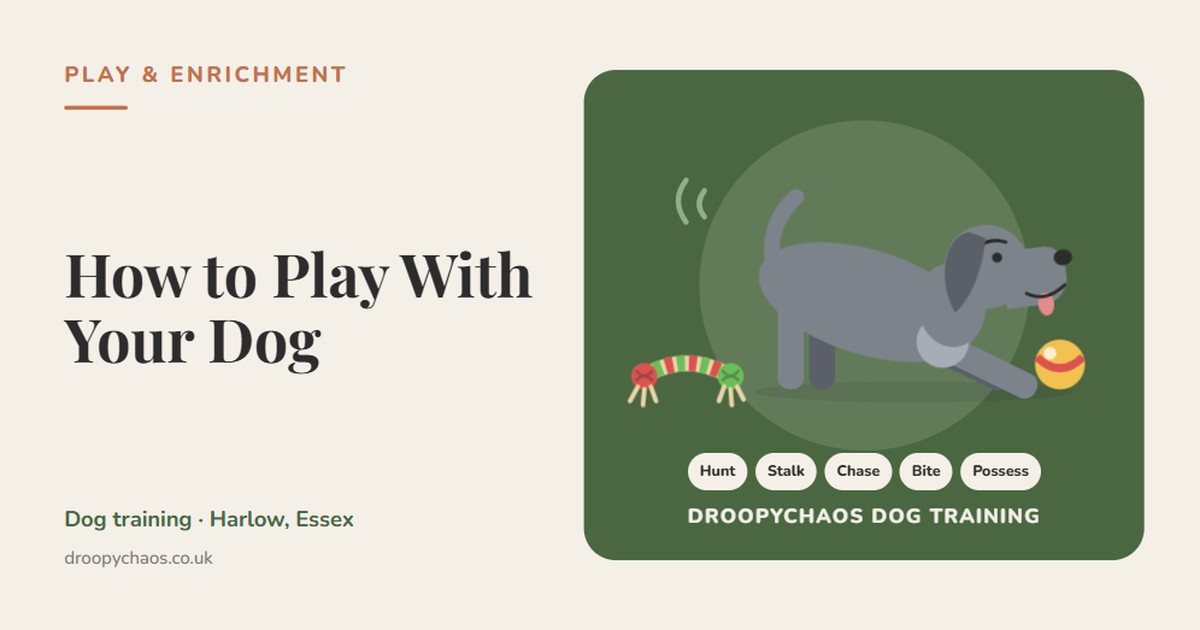
Stop buying new toys. Start watching your dog.
Your dog isn’t bored of their toys. They’re telling you which part of the hunt they love. Play isn’t one thing. Almost everything your dog loves about play comes from the hunting sequence. Get curious about which part is theirs, and play becomes the easiest way to fulfil them.
- 1Play comes from the hunting sequence: hunt, stalk, chase, bite, possess
- 2Most dogs have a favourite part. Some love the whole thing
- 3Watch where their energy peaks and where they switch off
- 4Build games around their favourite part
- 5Let them win: your dog should have the toy most of the time
- 6New to play? Keep it short, low and moving away from them
- 7A fulfilled dog is a calmer dog, at home and on walks
Play is the hunt, broken into pieces
Dogs have been shaped to do different jobs, and each job uses a different part of the same sequence. That sequence still drives what your dog finds exciting today.
How to find out what your dog actually enjoys
Offer, then watch
Try a few different games over the week. Don’t steer. Just notice what your dog does with each one.
Find the peak
When do their eyes light up? Is it while searching, the moment before you throw, the run, the grab, or once the toy is theirs?
Notice the switch-off
Where they lose interest tells you just as much. A dog who drops the ball the second it stops moving loves the chase, not the ball.
Games for each part of the hunt
The searcher
Nose down, always investigating, happiest on a sniffy walk.
Try: scatter feeding, hide a toy and let them find it, sniff trails in the garden.
The watcher
Freezes, crouches, eyes locked on the toy before it moves.
Try: flirt pole with long pauses, let the toy “hide” then creep out, reward the wait.
The runner
Lives for anything that moves. Loses interest when it stops.
Try: flirt pole, rolling a ball along the ground, chase-me games that finish with a recall.
The grabber
Grabs, tugs, shakes. The squeaker is never safe.
Try: tug with clear start and stop cues, shake toys, rope toys.
The keeper
Carries it off, parades it, settles down to shred it.
Try: let them win and carry it, safe shred boxes, trade games so giving it up pays.
Do
- Let them win sometimes
- Build in pauses so they practise calming down
- End while they still want more
- Mix up the parts they don’t love yet
Not yet
- Endless ball throwing (all chase, no finish)
- Snatching a toy from a dog who’s guarding it
- Only ever playing one way
- Playing until they’re over-the-top
Make your dog feel like a winner
For most dogs, having the toy is the prize. If you keep taking it off them, play starts to feel like a battle. If they win most of the time, they’ll want to play with you.
They should have it most of the time
Win, win, win. Your dog should be holding the toy for the majority of the game.
Keep it moving
While they have it, keep the game alive. Move with them, give it a gentle tug, make the toy feel like it’s still part of the fun.
Let their guarding win
When they settle down with it, go in like you’re going to retrieve it, but let their attempt to keep it win. They hold on, they keep it. Winner.
Lost interest? Bring it back to life
When they drop it and wander off, pick it up and get it moving again so the game starts afresh.
New to play? How to introduce it
Not every dog knows how to play with a person. Rescues, older dogs and anxious dogs often need to be shown that it’s safe and fun. Start here.
Start somewhere boring
At home or in the garden, with nothing else going on. Short sessions of 30 seconds to a minute are plenty.
Make the toy move like prey
Drag it along the floor, away from your dog, in little zigzags. Prey runs away. It never jumps into your face.
Let them win straight away
The second they show interest or touch it, let go. Show them that grabbing the toy pays off.
Pair it with food
If toys mean nothing yet, use a tug with a food pouch, or play find-it with food first, then hide a toy instead.
Stop before they do
End while they still want more. That’s what makes them keen to play next time.
Do
- Keep it low and moving away
- Get on their level and be a bit silly
- Celebrate tiny bits of interest
- Try different toys: fluffy, rope, squeaky, flirt pole
Not yet
- Waving the toy in their face
- Long sessions
- Playing when they’re worried or unsettled
- Taking it personally if they walk off
What is your dog hinting at?
Pick the answer you think fits. There’s a little explanation under each one.
1. Your dog spends the whole walk nose down and ignores the ball you brought. Which part do they love?
2. Your dog freezes and crouches, staring at the ball before you’ve even thrown it. Which part?
3. Your dog races after the ball but drops it as soon as it stops rolling. Which part?
4. Every new toy has its squeaker ripped out within ten minutes. Which part?
5. Your dog grabs the toy and trots off with it, and won’t bring it back. Which part?
6. Your dog loves every part: searching, stalking, chasing, grabbing and carrying. What does that mean?
Not sure what your dog is telling you?
In a focused 1-to-1 hour, we’ll work out which part of the hunt your dog loves and build games that actually fulfil them. You’ll leave with a play plan made for your dog.
Book a One Skill Workshop, £40 →Not ready yet? Learn to read your dog’s body language first →