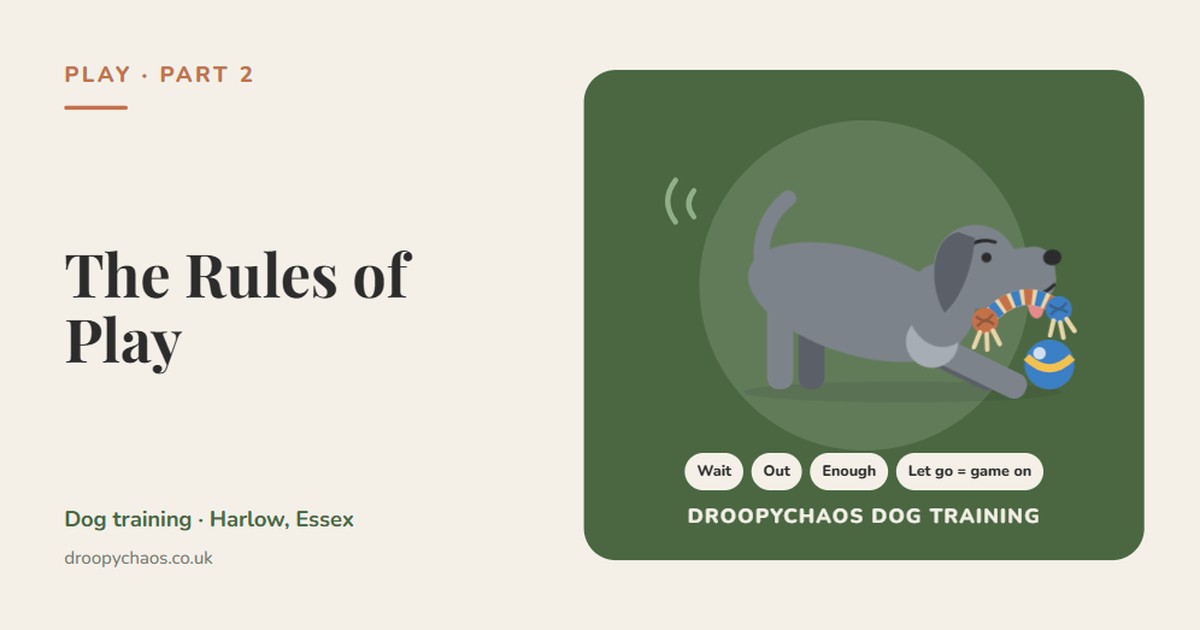
Play has rules. Your dog just needs to learn them.
Once your dog loves playing with you, play becomes one of the most powerful training tools you have. These are the simple rules I teach every dog: when to grab, when to let go, when the game ends, and how to use the toy as a reward.
- 1Toy up high? Don’t go for it. On their level or lower? Free game!
- 2Let them win, win, win before you ask for anything
- 3Out: hold the toy still, wait for a release, reward with more play
- 4End with a clear “enough” while they still want more
- 5Lift the toy, ask for a sit, reward with the game
- 6Notice whether toys or food motivate your dog more, and use both
High means wait. Low means free game!
The first rule is simple, and it keeps your hands and clothes safe. If the toy is up, your dog doesn’t go for it. If it’s on their level or lower, it’s free game.
Wait
Toy lifted above their head means pause. No jumping, no grabbing.
Free game!
Toy on their level or lower means go for it. That’s their green light.
Teaching the out (with patience)
Letting go of a toy they love is a big ask. There are lots of ways to teach it. These are the two I have the most success with. Either way, the key is the same: letting go gets rewarded with more play.
The toy method
Let your dog win, win, win. Then say a clear “out” and hold the toy still in a fixed position, a little higher than they can reach. No pulling. The moment they offer even a small release, reward with more play.
The food method
Patience is hard, and that’s normal. After playing, say a clear “out” and hold a piece of food right over their mouth. When they let go and move away from the toy to you, reward them, then start the game again.
Do
- Say “out” once, clearly
- Hold the toy completely still
- Reward tiny releases at first
- Restart play straight away as the reward
Not yet
- Pulling or yanking the toy
- Repeating “out, out, out”
- Ending the game every time they let go
- Getting frustrated, as they’ll feel it
Ending the game: “enough”
At some point the game needs to end so you can move on to something else. Give it a clear finish so your dog isn’t left guessing.
Pick up and move on
Pick up the toy, say “enough” and keep walking.
Put it away and praise
Say “enough”, put the toy away and praise them for finishing the game.
Using the toy as a reward
Once your dog loves the game, you can start asking for things in return.
Play a lot first
Build up plenty of fun and motivation before you ask for anything.
Find the break
When they’re really motivated, find a natural pause, lift the toy (remember, up means wait) and ask for a clear sit.
Let go = game on
When they release their grip on the toy, it’s game on! Reward straight away with more play, so letting go always pays off.
Toys or food? Use both, well
Some dogs would do anything for a toy. Others only light up for food. Most are a mix. Knowing which one drives your dog, and when, helps you choose the right reward for the job.
Toy
- Big energy and excitement
- Great for motivation, focus and recall
- Lets them fulfil their favourite part of the hunt
- Best when they need to move
Food
- Calmer and more precise
- Lots of quick repetitions
- Great for settling and new skills
- A good back-up when toys are too exciting
My tip: play in the morning
Early morning is a great time to play. Their brains are fresh and they can really stretch their legs. Ask for just a sit, then send them to the toy or reward them with it.
Then watch and learn
How good is their toy focus? How well can they listen to you when the toy is on offer? And which part of the game do they love: the stalk, the chase, the catch, the tug and ragdoll, or keeping it?
What would you do?
1. You lift the toy above your dog’s head and they start jumping at it. Do you…
2. You say “out” but your dog is clinging on. Do you…
3. Your dog is still having a brilliant time but you need to move on. Do you…
4. Mid-game, your dog stops and offers you a sit while staring at the toy. Do you…
Want help teaching the rules of play?
In one focused 1-to-1 hour, we’ll work on your dog’s play, the out and the off-switch, so play becomes a training tool rather than a free-for-all.
Book a One Skill Workshop, £40 →Start at the beginning: How to play with your dog →