Small changes that lower stress, build safety, and stop reactivity from getting worse
Learn to choose connection over conflict
Staying regulated while living and training with a reactive dog can become incredibly difficult. At times, it can feel like nothing you do is working — or worse, that every walk is slowly chipping away at your confidence and your relationship.
If you feel stressed about going on a walk before your dog has even started moving, that’s your cue to pause.
Something needs to change today.
Most reactivity starts before the lead even goes on. Dogs were never designed to navigate urban neighbourhoods, tight pavements, constant noise, unfamiliar dogs, and unpredictable humans — all while attached to a lead with constant opposing pressure. Expecting calm, friendly behaviour in those conditions requires skills that many dogs simply haven’t been taught yet.
It’s time to start using your time with your dog more effectively — not to “control” them, but to build clearer communication, trust in your relationship, and a deeper understanding of each other.
Reactivity isn’t bad behaviour.
It’s emotional overload in a nervous system that doesn’t yet have the skills to come back down.
Important warning: this post isn’t a quick fix.
It’s a starting point — with a plan.
Helping a reactive dog takes daily structure and intentional practice, and that starts with you, today.
Here are three things you can start doing right now to reduce stress and support your dog’s nervous system.
THING ONE: PRACTISE AROUSAL MANAGEMENT
Your dog is a living chemical organism that is constantly trying to maintain balance. Every experience releases chemicals that either push them up into excitement and stress, or allow them to come back down into calm and regulation.
What gets practised and rehearsed becomes more reliable and rewarding — and this applies to behaviours we like and behaviours we don’t.
Engagement is currency.
What you give your engagement to, you are paying for.
If most of your dog’s daily engagement happens when they are over-aroused, frantic, jumping, barking, or pulling — that’s the state of mind you’re unintentionally reinforcing.
As the handler, your job is to start creating predictable moments where your dog practises moving:
-
from low arousal → to high arousal
-
and from high arousal → back down to low arousal
This teaches the nervous system flexibility.
Simple ways to practise this:
-
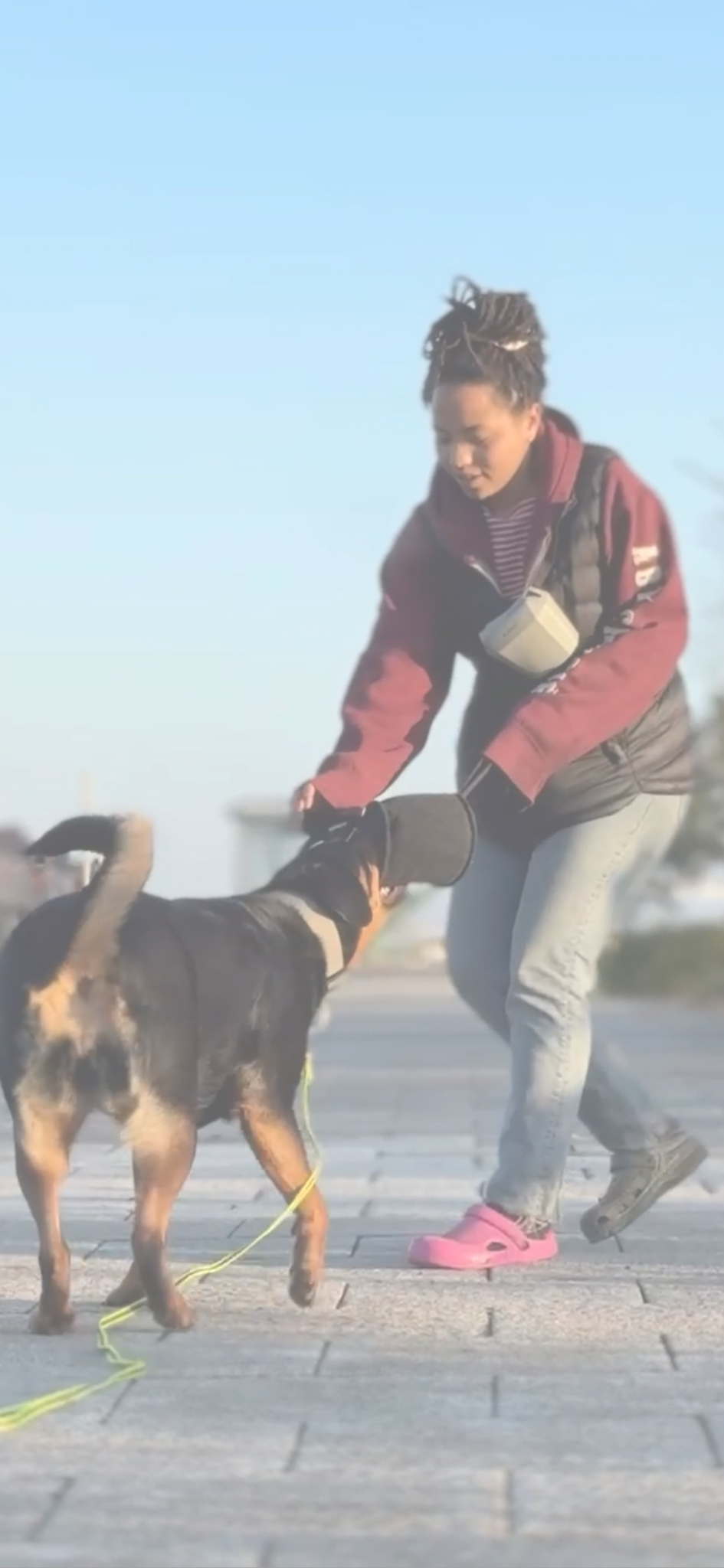
Tug and release on cue
-
Play and freeze
-
Wait and retrieve
-
Walk briefly then settle
This doesn’t need to be strict, long, or exhausting. In fact, it works best when it’s easy, repeatable, and something you both enjoy.
Three intentional minutes a day will do more for your relationship than an hour-long walk where your dog is dragging you down the street, emotionally flooded.
Ask yourself this honestly:
If you clip a lead onto a dog that is already running, jumping, barking, and frantic — what state of mind are they taking outside?
You’ve already paid for a nervous system that can only make emotionally charged decisions.
Start being intentional with what you pay.
Pay calm. Pay settled. Pay engagement when your dog’s brain is online and capable of learning.
At the same time, flip the script. Show your dog that high arousal is allowed and rewarded — but only in contexts you initiate for play, connection, and release.
This balance is what builds emotional resilience.
THING TWO: BUILD REALISTIC, RELIABLE BOUNDARIES
Here’s a hard but important question:
What happens when you ask your dog for something and they ignore you?
If nothing changes, your dog has just learned that ignoring you is an option — and over time, it becomes a reliable one.
Boundaries are not about being harsh or dominant.
They are about clarity, follow-through, and fairness.
Before asking anything of your dog, you need to check three things:
1. Are you setting them up to succeed?
Is the environment too difficult?
Is the arousal level already too high?
Is this something they can realistically do right now?
If the answer is no, change the situation — not the dog.
2. Do they actually know this skill?
Have you taught it calmly, in low distraction environments, and repeated it enough for it to be familiar?
If not, this isn’t disobedience — it’s a lack of understanding.
3. Are you willing to follow through?
If you ask for something and won’t hold it, don’t ask.
Dogs learn through consistency. A cue that sometimes matters and sometimes doesn’t quickly becomes meaningless.
This is where pressure comes in — not as punishment, but as information.
Understanding pressure
Pressure is simply a way of guiding behaviour, and it should always be:
-
Clear
-
Fair
-
Able to be turned on and off
Spatial pressure:
-
Stepping into space to block, guide, or influence movement
-
Releasing pressure the moment your dog makes a good choice
Lead pressure:
-
Gentle, intentional guidance
-
Never constant tension
-
Pressure turns off as soon as the dog responds
Pressure without release creates conflict.
Pressure with clear release creates learning.
When your dog learns that listening leads to comfort, clarity, and release — boundaries stop feeling threatening and start feeling safe.
THING THREE: PRACTISE WHAT YOU WANT REPEATED
Dogs repeat what works.
The more you initiate time to practise the behaviours you like, the more your dog will start offering them — and the more opportunities you create to reward calm, thoughtful choices.
Training doesn’t stop outside of sessions.
You are building a relationship with a being that doesn’t speak — every part of their day matters.
If most of your dog’s day is spent rehearsing:
-
pulling
-
reacting
-
ignoring
-
coping alone
Those are the skills they’ll get better at.
Instead, take three intentional minutes a day to show your dog:
-
Engagement with you matters
-
Calm choices are noticed
-
Slowing down is safe
-
Distance is always an option
The more you show your dog that:
-
you can create distance when things feel overwhelming
-
you will help them instead of pushing them
-
engagement with you feels more rewarding than emotional outbursts
…the more they will start choosing those options themselves.
And that’s when:
-
reactions reduce
-
recovery speeds up
-
close passes become possible
-
trust deepens
Make things slow.
Make them easy.
Make them rewarding.
This is how you build a dog who doesn’t just behave — but feels safe enough to think.
If your dog is already reactive, this takes time. That’s normal.
It’s not your fault your dog is struggling —
but it is within your control to change the pattern.
Progress doesn’t come from pushing harder.
It comes from clarity, consistency, and connection — practised daily.
If you want help applying this to your specific dog, a virtual call can save months of guessing and frustration.
You don’t need to do more.
You need to do things differently — on purpose.
WANT PERSONALISED SUPPORT?
If you’re finding this hard to apply to your own dog, you don’t need to keep guessing.
Every reactive dog needs a clear, achievable training plan — with realistic goals, appropriate pressure, and progress that can actually be repeated.
If you’d like personalised help to:
-
create a training plan that fits your dog
-
set achievable goals that build confidence instead of frustration
-
understand timing, boundaries, and engagement more clearly
-
stop practising the same reactive patterns
You have two options:
→ Book a Communication Intervention Virtual Call
A one-to-one session focused on understanding your dog, your environment, and what needs to change first to create reliable progress.
https://tidycal.com/anyango/virtual45mins
→ Attend our Reactivity Classes
A structured, supportive environment where dogs can practise regulation, distance, and engagement safely — without pressure to “be social”.
Both options are designed to help you move from surviving walks to building a calmer, more connected relationship.
Progress comes from clarity — not pushing harder.